Manufactured housing plays a major role in Arizona’s housing market, offering affordability, flexibility, and homeownership options across urban and rural areas. But one of the least understood aspects of owning a manufactured home is how it is classified under state law.
Is it personal property, like a vehicle? Or is it real property, like a site-built house?
The answer depends on a specific legal step: recording an Affidavit of Affixture. If you own a manufactured home (or plan to buy one) understanding this document and when it is required is essential.
What Is an Affidavit of Affixture?
An Affidavit of Affixture is a legal document recorded with the county that certifies that a manufactured home has been permanently attached to land and should be legally recognized as real property.
Before this affidavit is recorded, a manufactured home is generally classified as personal property and titled through the Arizona MVD (Motor Vehicle Division), much like a vehicle or motorcycle.
Once the affidavit is recorded:
- The home becomes part of the real estate parcel
- The MVD title is surrendered
- The home is taxed, financed, and legally treated as real property
In short, the Affidavit of Affixture is what transforms a manufactured home into official real estate.
Classification Matters: Personal Property vs. Real Property
As Personal Property (Before the Affidavit), a manufactured home is treated like a movable asset. It has:
- An MVD title
- Personal property tax rates
- Limited financing options, typically chattel loans (higher interest rates, shorter terms)
As Real Property (After the Affidavit), a manufactured home is treated the same as a site-built home:
- The land and home are legally one unit
- Property taxes are assessed as real estate
- Conventional, FHA, VA, and USDA loans become available
- Resale value often improves and transactions become smoother
For many Arizona homeowners, converting to real property is a major financial advantage, qualifying you for more traditional loans and more. An Affidavit of Affixture is Required in several common situations involving manufactured housing in Arizona:
1. Converting a Manufactured Home to Real Estate
If you want your home legally recognized as real property, rather than personal property, you must record an Affidavit of Affixture.
This is often done when:
- You own the land beneath the home
- You want to improve resale value
- You need access to traditional mortgage financing
- You want the home taxed with the land as one property
2. Getting a Traditional Mortgage or Refinance
Most lenders will not issue a traditional mortgage on a manufactured home unless it has already been converted to real property. Including:
- Conventional loans (Fannie Mae, Freddie Mac)
- FHA Title II mortgage
- VA loans
- USDA loans
If the home is still titled through the MVD, lenders typically require the Affidavit of Affixture as a mandatory condition before loan approval.
3. Selling the Home and Land Together
If a buyer is financing the purchase, or if a clean real estate transaction is desired, the home must be classified as real property. Without the affidavit you may experience the following issues, preventing a smooth transaction:
- The home still has a vehicle-style title
- Title transfer must go through both the MVD and the county
- The buyer may not be able to obtain financing
Recording the affidavit makes the home part of the real estate, allowing it to be sold just like any other house.
4. Updating Property Taxes
In Arizona, manufactured homes that remain personal property are taxed differently than real estate. By recording an affidavit it affects your home in the following ways:
- Moves the home to the county assessor’s real property roll
- Eliminates personal property tax assessments
- Combines the home and land under a single real estate parcel
This is important for homeowners seeking tax consistency and long-term predictability.
However there are certain requirements before you can file an Affidavit of Affixture (Arizona-Specific). Arizona has specific requirements that must be met before the affidavit can be recorded. These typically include:
1. Permanent Foundation – The home must be installed on a permanent foundation system compliant with HUD and state building standards.
2. Ownership of the Land – The homeowner must:
- Own the parcel outright or
- Have a qualifying long-term lease (rare, specific situations)
3. Surrender all of the MVD titles for the home, including for double or triple wide section homes, must be surrendered.
4. The home must have HUD Labels and Data Plate Present
- Exterior HUD certification labels (red metal tags)
- Interior data plate with manufacturer details
These verify that the home meets federal building standards.
5. If the home was previously financed as personal property, all lenders must issue releases before conversion.
6. And finally, the county assessor must confirm that the home qualifies as real property before recording can proceed.
After the Affidavit of Affixture is recorded:
- The home becomes part of the land legally
- It is taxed as real property
- It becomes eligible for traditional financing
- Future sales are handled through standard real estate processes
- No further MVD titling is required
In practical terms: the home becomes indistinguishable from a site-built home in the eyes of the law.
Why This Matters to Arizona Homeowners
Arizona has one of the highest percentages of manufactured homes in the United States, especially in rural and suburban counties. As the market grows, many buyers and owners want:
- Access to affordable traditional mortgages
- Higher resale value
- Simplified real estate transactions
- Standardized taxation
- Long-term stability
Recording an Affidavit of Affixture is the key step for achieving all of the above.
For Arizona homeowners, the Affidavit of Affixture is more than a piece of paperwork, it’s the legal bridge that transforms a manufactured home from personal property into true real estate. Whether you’re purchasing a home, applying for financing, preparing to sell, or updating your property records, understanding when and why this document is required helps protect your investment and unlocks meaningful financial benefits.
Below is a clear, detailed, step-by-step guide specifically for Arizona homeowners who need to file an Affidavit of Affixture to convert a manufactured home from personal property to real property.
Step-by-Step Guide: Filing an Affidavit of Affixture in Arizona
How to convert your manufactured home from personal property to real estate
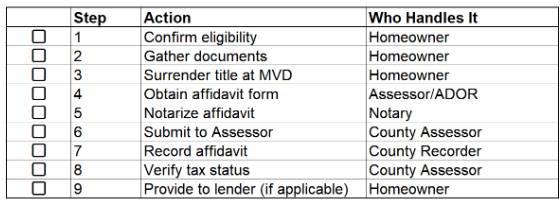
Converting a manufactured home to real property in Arizona requires coordination between the Arizona MVD, County Assessor, County Recorder, and, if you have a loan, your lender. This guide walks you through the exact steps in the correct order.
STEP 1: Confirm You Qualify for Conversion
Before starting, make sure your home meets Arizona’s requirements:
You must own the land where the home is installed (Or in rare cases, have a long-term, recorded lease that qualifies.)
- The home must be on a permanent foundation: HUD-compliant piers, runners, masonry, or engineered foundation.
- The home must have HUD certification labels and the interior data plate: These must be intact, Arizona cannot convert the home without them.
- Any personal-property liens must be released If you financed the home with a chattel loan, the lender must release the title.
- If you meet these criteria, move to Step 2.
STEP 2: Gather the Required Documents
You will need:
- Manufacturer’s Certificate of Origin (if new), or
- Current MVD Title(s) for each section of the home
Single section home = 1 title
Two section home = 2 titles
Three section home = 3 titles
- Lien Releases – If a lender previously held a personal-property lien.
- Proof of Land Ownership
- Recorded deed or title report.
- Foundation Inspection or Engineering Certification (recommended/required by some lenders); Ensures the home qualifies as a permanent structure.
STEP 3: Visit the Arizona MVD (or Authorized Third-Party) to Surrender the Title
To convert the home to real property, its MVD vehicle-style title must be surrendered. At the MVD office you will:
- Submit the MVD title(s)
- Provide lien releases
- Request the home be listed as “Affixed”
- Receive a form verifying title surrender (This MVD document is required for your affidavit package).
STEP 4: Obtain the Arizona “Affidavit of Affixture” Form
You can get the form from:
- The Arizona Department of Revenue (ADOR)
- Your County Assessor’s Office
- Your County Recorder’s Office
This form includes required details about:
- Home manufacturer
- Serial number / VIN
- HUD certification labels
- Dimensions
- Foundation type
- Parcel number for the land
- Title surrender confirmation
STEP 5: Have the Affidavit Notarized
The Affidavit of Affixture must be signed in front of a notary by:
- Every homeowner listed on the title/deed
- (If new purchase) your lender may also need to sign
Do not sign before the notary appointment.
STEP 6: Submit the Affidavit to the County Assessor
Take your notarized affidavit and supporting documents to your County Assessor’s Office.
They will:
- Verify the home meets real-property requirements
- Verify HUD labels and serial numbers
- Update the home to the assessor’s real property roll
- Stamp or certify the affidavit for recording
Important: Some counties require a physical inspection before approval.
STEP 7: Record the Affidavit with the County Recorder
After the Assessor certifies the affidavit, take it to the County Recorder to make it official.
- You will need to Pay the recording fee (Usually between $30–$50 depending on county)
- Record the affidavit under the property parcel
Once recorded, the affidavit becomes part of the land record.
STEP 8: Confirm the Conversion on the County Tax Roll
Within 30–60 days, check with the County Assessor to confirm:
- The home now appears as “real property”
- Assessed value and taxes are updated correctly
- The personal property account (if one existed) has been closed
This ensures there are no future tax or title issues.
STEP 9 (If Financing): Provide the Recorded Affidavit to Your Lender
If you are purchasing, refinancing, or converting the home to meet a loan requirement:
- Send the lender the recorded affidavit
- Provide any engineering or foundation certifications
- Ensure loan underwriting is updated to “real property classification”
Most traditional mortgages cannot close until this is completed.
What Happens After the Process Is Complete
Once all steps are finished:
The home is legally part of the real estate
The MVD title is permanently retired
The home becomes eligible for traditional mortgages
Future sales involve only the land deed – no MVD title
Property taxes are assessed as real property
The home is treated just like a site-built home in the eyes of Arizona law
Quick Reference Checklist